
The Enterprise Tech SEO Reality Check: Beyond Dogma, Paywalls, and the JS Myth

I've spent years sitting in room after room with product leads, engineers, and execs. And if there's one pattern I see repeating across search, it's this: there is a massive disconnect between dogmatic SEO advice and what it actually takes to run a website with millions of visits.
Too many agencies, consultants, and automated audit tools rely on rigid, copy-paste checklists. They hand over a 90-page audit full of low-impact fixes (demanding micro-trims to DOM depth, total elimination of unused CSS, or a complete rewrite of the codebase) without ever proving how any of it will actually move the needle on rankings, traffic, or revenue.
Sorry but I have to say that, in the enterprise world, especially for massive digital publishers, developers aren't your enemies, and site perfection is a total myth. Here's my no-BS framework for how enterprise technical SEO actually works when real money, engineering time, and monetisation stacks are on the line.
1. The Illusion of Technical SEO "Best Practices"
Let's be real for a second: a huge chunk of traditional tech SEO advice relies on assumptions rather than actual proof.
I've worked with external agencies and consultants, and they love dumping a list of 500 "errors" flagged by an automated crawler because it makes them look busy. But as experienced technical SEOs, we have to know the difference between baseline technical hygiene and actual growth drivers.
- Baseline Hygiene: Making sure pages can actually be indexed, fixing canonical loops, unblocking search bots, and keeping the site alive. These don't guarantee growth; they just keep you in the game.
- Growth Drivers: Building smart, scalable internal linking, fixing indexation strategy for millions of dynamic URLs, and making sure primary page templates load insanely fast for real users.
When we ask for 200 hours or endless story points of dev time just to trim a DOM tree from 1,400 nodes down to 1200, without any proof that Google is actually struggling to render the page, we lose credibility with leadership, product teams, BAs and everyone else at the table.
2. Two Different Worlds: Greenfield Startups vs. Enterprise Giants & Publishers
Advice that makes total sense for a brand-new website often completely breaks down when you try applying it to a massive enterprise site.
The Greenfield Ideal
When you're building a site from scratch, enforcing super clean HTML, light CSS, small DOM sizes, and fast render paths is pretty easy. Engineering costs are low, there's no legacy tech debt, and setting performance rules early saves you a ton of headaches later.
The Enterprise Reality
Scale changes everything. When you manage an enterprise stack pulling in millions of visits, you aren't working with a clean slate. You're inheriting years of tech debt, global CDN setups, localised content feeds, and dozens of third-party tools.
Demanding a full site replatform or complete refactor "because it's better for SEO" is usually a rookie mistake. A migration of that size carries insane business risk, costs a fortune, and almost guarantees months of traffic turbulence. Our job isn't to ask for a brand-new car; it's to make the existing engine run as fast as possible.
| Standard SEO Advice | Enterprise & Publisher Business Reality |
|---|---|
| "Ditch third-party JavaScript to fix your speed scores." | Dynamic ad stacks and header bidding bring in the money that keeps the lights on. |
| "Make all content open and accessible to everyone." | Smart paywalls dynamically block or show content based on how likely a user is to subscribe. |
| "Rebuild the whole site in static HTML for better indexation." | Engineering roadmaps focus on uptime, security, and core features before big SEO refactors. |
The Publisher Monetisation Balancing Act
This trade-off is most obvious in digital publishing. Media outlets operate in a tough market where organic traffic is constantly squeezed. To stay profitable, publishers have to get every cent of value out of every single visit.
That means running smart, dynamic paywalls that predict whether a reader will subscribe, right alongside heavy ad tech setups with header bidding and real-time auctions.
Telling a publisher to rip out their ad tags or bypass their paywall code just to score higher on PageSpeed Insights shows you don't understand how their business works. If an SEO recommendation kills the revenue model keeping the business alive, it's a bad recommendation. Period.
3. The JS Pragmatism: SSR Idealism vs. Enterprise Reality
JavaScript is easily one of the most debated topics in tech SEO. Let's look at it pragmatically.
Let's Be Honest: SSR Is the Gold Standard
I'll be the first to admit it: Server-Side Rendering (SSR) or pure pre-rendered HTML is undeniably the gold standard for SEO.
If you serve fully rendered HTML straight from the server, you skip client-side rendering bottlenecks, eliminate Googlebot's two-pass indexing delay, save mobile CPU power, and score way better on Core Web Vitals. If you can build and maintain a pure SSR or static setup at scale, you absolutely should. Great, well done, but for most enterprise teams that's not the reality they're operating in.
                             [ THE RENDERING SPECTRUM ]

     Pure Static HTML                 Hybrid / SSR                    100% Client-Side (CSR)
  ┌────────────────────┐         ┌────────────────────┐         ┌────────────────────┐
  │ • Instant indexing │         │ • Best SEO balance │         │ • Heavy browser JS │
  │ • Zero dynamic UX  │  ◄────► │ • Complex setup    │  ◄────► │ • Rich dynamic UX  │
  │ • Hard to scale    │         │ • High server cost │         │ • Needs smart dev  │
  └────────────────────┘         └────────────────────┘         └────────────────────┘
The Real-World Publisher Dilemma
That said, in the chaotic world of enterprise newsrooms and complex digital platforms, keeping everything on 100% pure HTML without any JavaScript across every single page and widget is nearly impossible. Go try pitching that to a publisher whose homepage carries more ad slots than actual headlines; they'll laugh you out of the sprint planning meeting.
Between managing real-time breaking news traffic spikes, personalising content blocks, processing subscription paywalls on the fly, and running ad auctions in milliseconds, client-side execution (CSR) or hybrid hydration is often the only realistic option for product teams.
Telling an enterprise product team to throw out their client-side single-page app (SPA) because "JS is bad for SEO" ignores business realities. The massive cost of a full re-architecture rarely justifies the potential SEO lift.
A Real-World Example: How We Hit Google Top Stories on 100% CSR (Over 1M Organic Clicks)
To prove that good execution beats dogmatic perfection, here's a real-world example from my work with a major news publisher.
We were working with a critical template built entirely on a 100% Client-Side Rendered (CSR) setup. Standard SEO rules say CSR is terrible for breaking news because Google delays rendering JS until it has spare processing power, which can cost you precious minutes or hours during a news event.
Instead of demanding a multi-month SSR rebuild that dev teams couldn't prioritise anyway, we optimised what we had:
- Google News XML Sitemap: Made sure the page was in the Google News XML sitemap the moment it went live, so Google could discover it immediately.
- Internal Promotion: Promoted the page hard on our own website (homepage placement and internal links) instead of waiting on Google alone to do the work.
- Genuinely Good User Experience: An incredibly good user experience, full stop. No clutter getting between the reader and the story.
- No Paywall: The page was completely free. No paywall. Don't ask me why.
The Result: The 100% CSR template didn't just get indexed; it consistently landed in Google Top Stories during major breaking news cycles, driving over 1 million organic clicks over the campaign window. (Of course, this particular page was for the World Cup.)
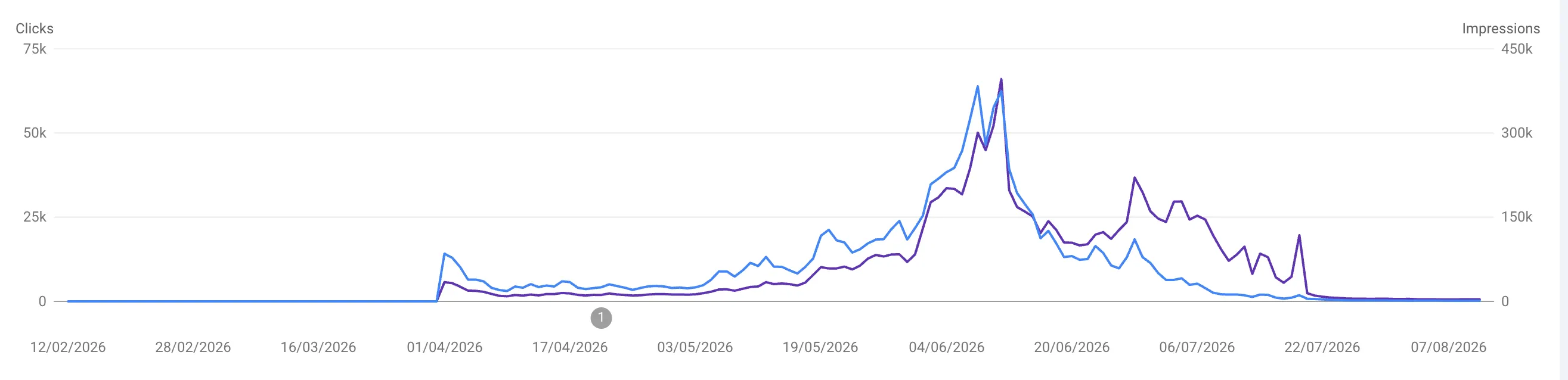
SSR is still a must for some templates. But this proves a simple point: a well-optimised client-side setup will beat a sloppy server-side setup every single time. Execution and fine-tuning matter way more than fighting over frameworks.
The New Wrinkle: Serving a Different Format to AI Bots
There's now a fourth rendering path getting hyped in every LinkedIn
post: serving a lightweight, stripped-down HTML page, or a plain .md file, specifically to AI crawlers (ChatGPT-User, ClaudeBot,
PerplexityBot and friends) instead of your normal page. I know this will
save tokens and it's more efficient for the bots to parse.
Here's my honest take: I haven't seen a single case study proving this actually moves the needle on traffic from Google's AI Mode or AI Overviews, or from LLMs such as ChatGPT and Claude. Everyone's doing it on faith.
I built a tool that checks exactly what content gets served to different LLM bots versus what a normal browser sees. So far, out of everyone I've tested, only three publishers are actually doing it:
- TIME Magazine: Serves a
.mdformat to bots, and still runs ads inside it.

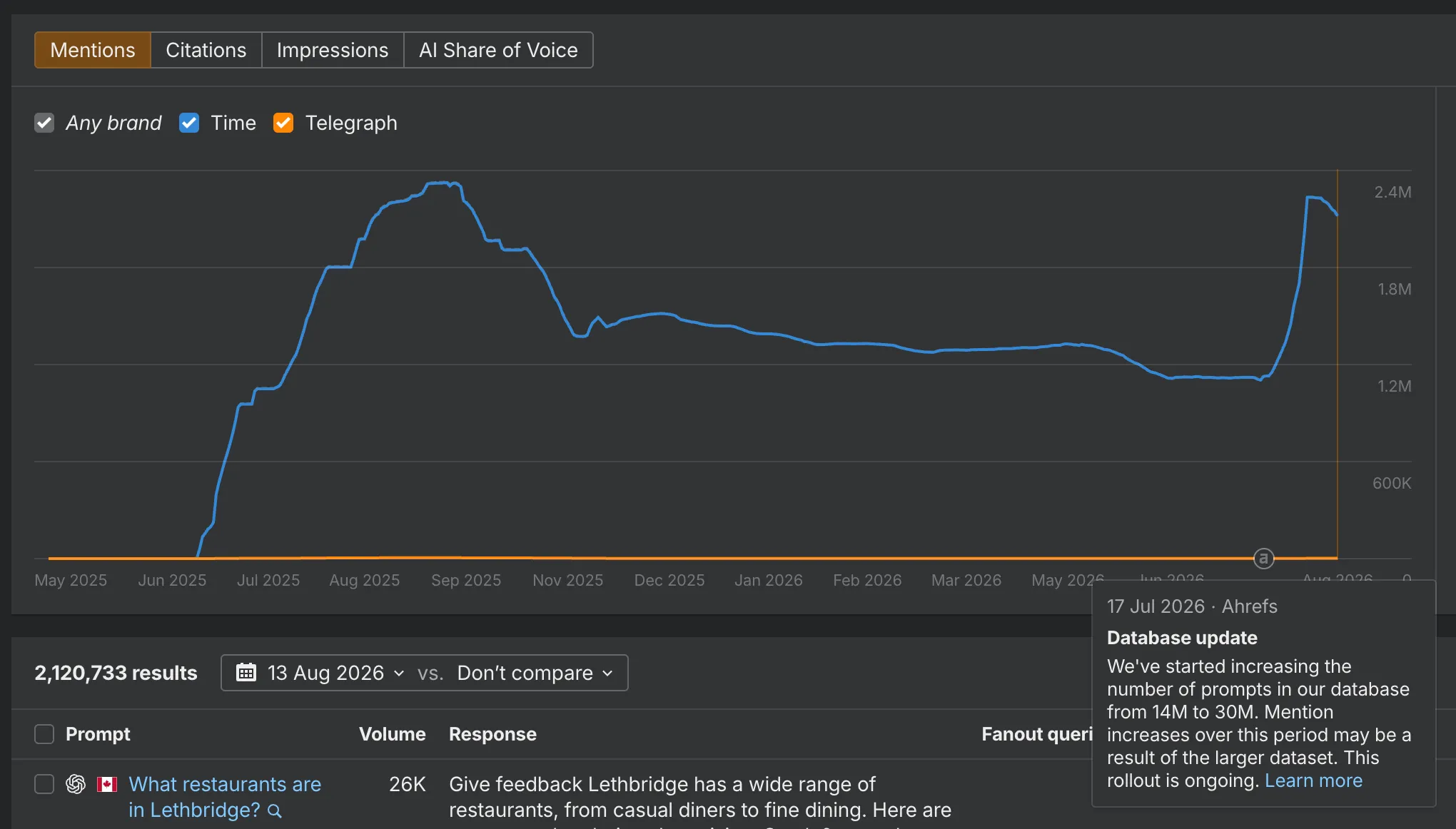
So does it actually work? I can't see any real impact on TIME's mentions or citations over the last couple of months, assuming we agree this counts as a new technique worth measuring against. The one spike in the chart below isn't organic growth: it lines up exactly with Ahrefs expanding its prompt database from 14M to 30M prompts, which explains the jump in the graph on its own.
- Akamai: Serves a lightweight, stripped-down HTML.
- Cloudflare: Serves a
.mdfile.

That's it. Three, out of an enterprise web that supposedly can't wait to roll out AEO. Until someone publishes real before/after numbers, treat this the same way you'd treat any other "best practice": an interesting theory, unproven in production.
For the record: I do think optimising a page for AI agents is a good idea. I believe in the Agentic Web, and I've written about why in a separate article on Agentic Engine Optimisation . But we're at a very early stage, and there needs to be a mechanism to prevent cloaking, the same problem Google dealt with a long time ago on the regular web. If it's possible to serve one version of a page to an AI agent that stays invisible to everyone else, that channel can just as easily be used for negative manipulation as it can for advertising.
4. Developers Are Not Your Enemies: Building the Alliance
A huge turning point in any technical SEO's career is moving from a "me vs. them" mindset with developers to an actual partnership. Engineers don't hate SEO; they just hate vague, unprioritised tickets that mess with their sprint goals.
If you want to get things done at scale, you have to talk their language and adapt to how they work.
5. Enterprise SEO Is an Ultra-Marathon, Not a Sprint
Enterprise technical SEO takes time. Scoping, prioritising, building, QA testing, and releasing changes takes weeks, and then you still have to wait for search engines to re-crawl and re-evaluate everything.
To keep your sanity and stay focused, use a simple priority framework to rank requests before bringing them to product teams:
                  HIGH IMPACT
                       │
     Quadrant 1        │        Quadrant 2
   CRITICAL REVENUE    │   SCALABLE ARCHITECTURE
   (Canonical Loops,   │   (Programmatic Linking,
    Indexation Blocks) │    Automated Schema)
                       │
 LOW EFFORT ───────────┼─────────── HIGH EFFORT
                       │
     Quadrant 3        │        Quadrant 4
   NICE-TO-HAVE        │   DOGMATIC DISTRACTIONS
   (Minor CSS Cleanup, │   (Full Replatforming,
    Redirect Chains)   │    Zero Unused JS)
                       │
LOW IMPACT - Critical Revenue Fixes (High Impact, Low/Med Effort): Fixing broken indexation rules, canonical loops on high-value templates, or broken paywall schema.
- Scalable Architecture (High Impact, High Effort): Building automated internal linking systems, setting up edge rendering, or re-architecting XML sitemaps for millions of URLs.
- Nice-to-Have Hygiene (Low Impact, Low Effort): Fixing minor 301 redirect chains, cleaning up small CSS bloat, or updating old meta tags.
- Dogmatic Distractions (Low Impact, High Effort): Trying to rewrite entire JS frameworks, chasing a perfect 100/100 PageSpeed score on ad-heavy pages, or demanding manual DOM rewrites on old legacy templates.
The Pragmatic Enterprise SEO Checklist
If we want technical SEO to be taken seriously at the executive level, we have to move past rigid audit checklists and theoretical rules.
- Question every request: If you can't explain the business value or measure the impact, don't put it in a dev sprint.
- Respect how the site makes money: Understand the business model (whether it's subscriptions, ads, or affiliate links) and build your SEO strategy around those realities.
- Acknowledge engineering trade-offs: SSR is great, but well-tuned CSR can still win. Clean code is nice, but feature velocity and site uptime matter too.
- Respect developer bandwidth: Dev time is expensive and limited. Bring well-scoped, data-backed solutions instead of vague problems.
Enterprise technical SEO isn't about making a site "perfect" for a crawler tool. It's about making your actual, real-world tech stack perform insanely well in search.
Key takeaways
- Separate baseline hygiene from growth drivers: don't spend engineering capital on fixes that don't move rankings or revenue.
- Paywalls and ad tech aren't obstacles to remove; they're the business model. Build SEO strategy around them, not against them.
- SSR is the gold standard, but a well-optimised CSR setup can still land in Google Top Stories: execution beats framework dogma.
- Talk developers' language and adapt to how they work: that's how you win developer trust, not by dumping tickets on them.
- Prioritise with an impact-vs-effort matrix and avoid Quadrant 4 "dogmatic distractions" that burn dev time for no measurable gain.
Don't get me wrong. I'm a huge advocate of SSR and clean HTML/CSS. But we have to learn what's actually moving the needle, and follow the money (and the user).
